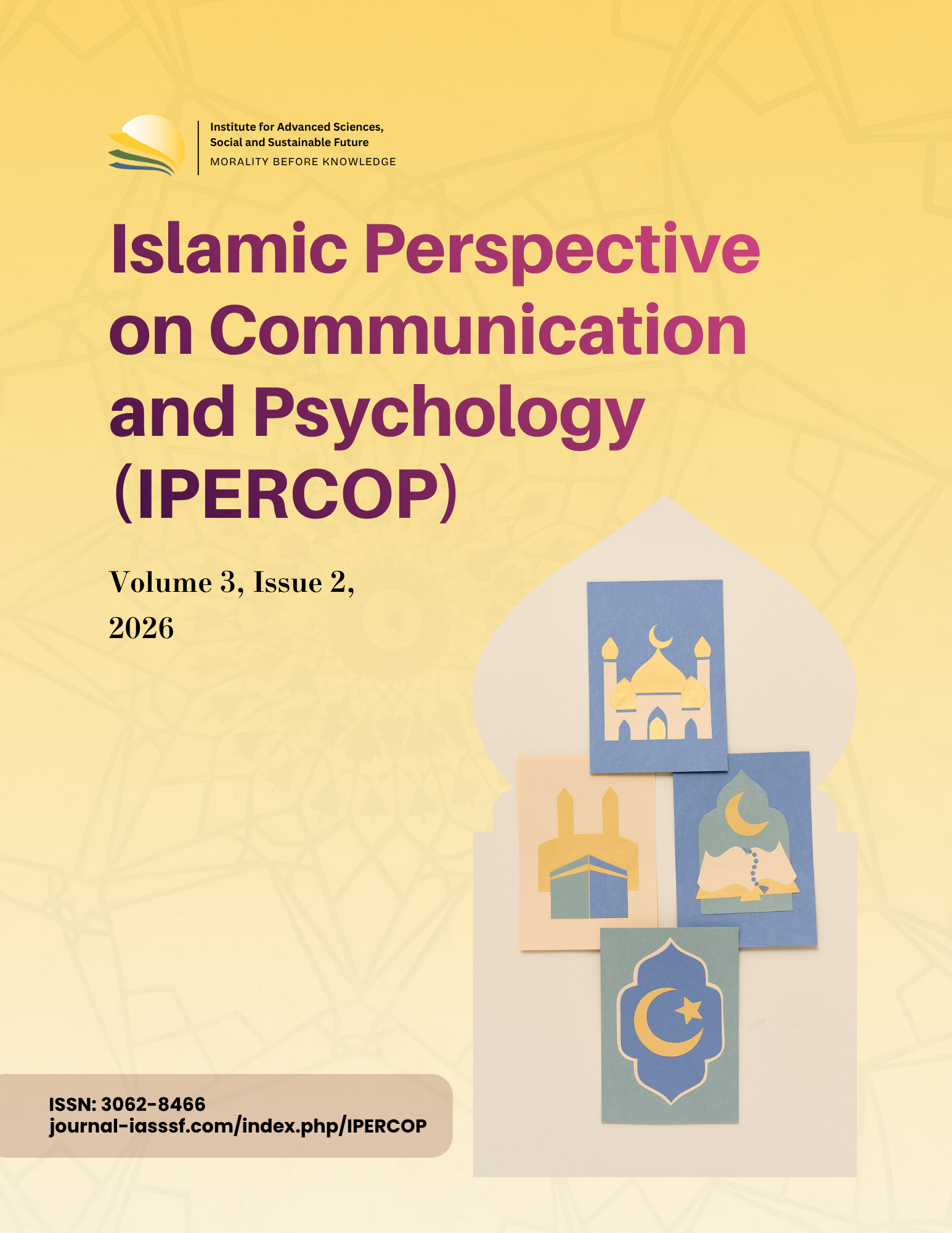
Religiosity as a psychological force in developing motivation and academic discipline among Muslim students
DOI:
https://doi.org/10.61511/ipercop.v3i2.2026.2645Keywords:
academic discipline, academic motivation, psychological strength, religiosityAbstract
Background: The decline in enthusiasm and discipline in learning poses significant challenges for students in the midst of modern era disruptions. While previous literature has often addressed academic aspects separately, religiosity is seen as having an important role as an internal psychological force. This study aims to analyze the influence of religiosity on the academic motivation and discipline of Muslim students at the Faculty of Teacher Training and Education (FKIP) Universitas Sriwijaya. Methods: This study uses a quantitative method with a correlational approach. Data were collected using a Likert scale questionnaire from 108 students of the Faculty of Teacher Training and Education, Sriwijaya University, which were selected using proportionate stratified random sampling. Data analysis techniques include Spearman correlation tests and simple linear regression to measure the magnitude of influence between variables. Findings: The results of the study showed that religiosity had a positive and significant influence on academic motivation with a contribution of 33.0%, and a positive effect on academic discipline with a contribution of 18.8%. In addition, a strong relationship was found between motivation and academic discipline with a coefficient value of 0.780. These findings confirm the theory that spiritual values serve as internal resources that reinforce students' self-regulation. Conclusion: It is concluded that religiosity functions effectively as a psychological foundation that strengthens students' mental resilience, transforming religious values into productive and responsible academic behaviors. Novelty/Originality of this article: The novelty of this research lies in the integration of the concept of psychological capital in the context of teacher education, which fills a gap in previous literature that tends to examine the variables of religiosity and academic performance in part without highlighting psychological power holistically.
References
Abdel-Khalek, A. M., & Lester, D. (2017). Religiosity and well-being: A cross-cultural study. Mental Health, Religion & Culture, 20(6), 1–11. https://doi.org/10.1080/13674676.2017.1375463
Ahmad, S. Z., & Al-Karasneh, S. M. (2021). The Impact of Islamic Religiosity on Academic Self-Efficacy and Resilience among Muslim University Students. International Journal of Islamic Thought, 19(1), 12-25. https://doi.org/10.24035/ijit.19.2021.191
Alghamdi, M. (2020). Intrinsic religiosity as a predictor of academic persistence in university students. Journal of Educational Psychology, 112(3), 495–508. https://doi.org/10.1037/edu0000387
Amalia, R. M., Syariful, S., Nabiela, F., & Latifa, A. (2021, February 12). Relation of personality and religiosity with academic motivation. Proceeding of Inter-Islamic University Conference, 1(1). Universitas Al Azhar Indonesia. https://doi.org/10.21070/iiucp.v1i1.628
Ariani, D. W. (2021). The role of religiosity and spirituality in motivating and improving students’ performance in Indonesia, 34(8), 52–63. https://doi.org/10.9734/jesbs/2021/v34i830351
Astin, A. W., & Astin, H. S. (2019). Meaning, spirituality, and student success: A psychological perspective. Journal of College Student Development, 60(2), 125–142. https://doi.org/10.1353/csd.2019.0012
At Thohiroh, S., & Wisma, N. (2025). Pengembangan e-booklet pada layanan bimbingan kelompok sebagai upaya pencegahan prokrastinasi akademik mahasiswa. Jurnal Teknologi Pendidikan, 24(2):919-931, 10.17509/e.v24i2.83089
Beyers, W., Goossens, L., & Luyckx, K. (2019). Identity formation and spiritual development in emerging adulthood. Journal of Adolescence, 72, 41–51. https://doi.org/10.1016/j.adolescence.2019.01.001
Biro Kemahasiswaan Universitas Sriwijaya. (2024). Laporan Evaluasi Akademik Mahasiswa FKIP Tahun 2024. Palembang: Universitas Sriwijaya Press.
Creswell, J. W. (2014). Research Design: Qualitative, Quantitative, and Mixed Methods Approaches (4th ed.). Thousand Oaks, CA: SAGE Publications. https://facultystaff.richmond.edu/~jboehman/edlp/Creswell_Research_Design.pdf
Firdaus, S. M., & Zamri, K. (2020). The role of Islamic educational programs in shaping students’ moral reasoning and academic behavior. International Journal of Instruction, 13(4), 251–266. https://doi.org/10.29333/iji.2020.13416a
Hidayat, R., & Latifah, S. (2022). Religiosity and Intrinsic Motivation: A Path Analysis on Academic Discipline in Islamic Higher Education. Journal of Islamic Education and Ethics, 4(2), 88-102. https://doi.org/10.14421/jiee.2022.42-03
Holder, M. D., Coleman, B., & Wallace, J. M. (2018). Academic integrity and religiosity among university students. Journal of Moral Education, 47(2), 223–238. https://doi.org/10.2991/assehr.k.200728.043
Jenaabadi, H., Fotouhi, M., & Yaghobi, A. (2015). The relationship between religious coping, academic resilience, and academic burnout among university students. Journal of Religion and Health, 54(1), 241–252. https://doi.org/10.1007/s10943-013-9811-2
Kemendikbudristek. (2023). Survei Nasional Kesejahteraan Mahasiswa Indonesia. Jakarta: Pusat Data dan Analisis Pendidikan.
Khan, Z., & Watson, P. J. (2021). Religiosity and self-actualization in humanistic psychology: A transcendence perspective. Journal of Humanistic Psychology, 61(3), 312–329. https://doi.org/10.1007/978-94-017-9436-7
King, P. E., & Boyatzis, C. J. (2015). Religious and spiritual development in adolescence. Journal of Youth and Adolescence, 44(10), 2009–2023. https://doi.org/10.1007/s10964-015-0313-8
Krause, N., & Hayward, R. D. (2015). Religion, meaning in life, and change in physical functioning during late adulthood. Journal of Adult Development, 22(3), 201–211. https://doi.org/10.1007/s10804-015-9218-5
Luthans, F., & Youssef-Morgan, C. M. (2017). Psychological capital and beyond. Oxford University Press.
Masang, A. (2021). Hakikat pendidikan. Al-Urwatul Wutsqa: Kajian Pendidikan Islam, 1(1). https://journal.unismuh.ac.id/index.php/alurwatul/article/download/5492/3767?utm_
Maslow, A. H. (1971). The farther reaches of human nature. Viking Press. https://api.semanticscholar.org/CorpusID:143652560
McCullough, M. E., & Willoughby, B. L. (2009). Religion, self-regulation, and self-control: Associations, explanations, and implications. Psychological Bulletin, 135(1), 69–93. https://doi.org/10.1037/a0014213
National Achievement Center (Pusat Prestasi Nasional/Puspresnas). (2023). Laporan Capaian dan Evaluasi Karakter Akademik Mahasiswa Indonesia: Tantangan Pascapandemi dan Distraksi Digital. Jakarta: Pusat Prestasi Nasional, Kementerian Pendidikan, Kebudayaan, Riset, dan Teknologi. Tersedia dari https://pusatprestasinasional.kemdikbud.go.id/
Rahman, A. F., Husni, M., & Zulfikar, Z. (2023). Academic Resilience and Islamic Spirituality: A Study of Muslim Students' Coping Mechanisms in Digital Era. Religious Education Journal, 118(3), 310-328. https://doi.org/10.1080/00344087.2023.2182414
Rohmat, F., & Nisa, R. (2022). Dimensi spiritualitas dan aktualisasi diri mahasiswa Muslim. Jurnal Psikologi Islam, 9(2), 45–57. https://doi.org/10.47399/jpi.v9i2
Ryan, R. M., & Deci, E. L. (2000). Intrinsic and extrinsic motivations: Classic definitions and new directions. Contemporary Educational Psychology, 25(1), 54–67. https://doi.org/10.1006/ceps.1999.1020
Ryan, R. M., & Deci, E. L. (2000). Teori penentuan nasib sendiri dan fasilitasi motivasi intrinsik, perkembangan sosial, dan kesejahteraan. Psikolog Amerika, 55, 68–78. https://selfdeterminationtheory.org/SDT/documents/2000_RyanDeci_SDT.pdf
Saroglou, V. (2019). The psychology of religion: A comprehensive approach. International Journal for the Psychology of Religion, 29(4), 241–255. https://doi.org/10.1080/10508619.2019.1654341
Sihite, M. P., & Maria, E. (2022). Religiusitas dan perilaku kecurangan akademik mahasiswa di masa pandemi Covid-19. AFRE Accounting and Financial Review, 5(3), 321–330. https://doi.org/10.26905/afr.v5i3.8049
Souri, H., & Hasanirad, T. (2011). Relationship between resilience, optimism, and psychological well-being in students. Procedia - Social and Behavioral Sciences, 30, 1541–1544. https://doi.org/10.1016/j.sbspro.2011.10.299
Sugiyono. (2021). Metode penelitian kuantitatif, kualitatif, dan R&D. Alfabeta.
Tsanawiyah, M., Pesantren, P., & Ra, I. Q. (2018). Hubungan religiusitas dengan kedisiplinan santri pada Madrasah Tsanawiyah Pondok Pesantren Iqra’. https://repository.uinib.ac.id/1267/9/full%20gabungan.pdf
Wahdi, A. E., et al. (2023). Indonesia – National Adolescent Mental Health Survey (I-NAMHS) Report. Yogyakarta: Pusat Kesehatan Reproduksi, Universitas Gadjah Mada. Retrieved from https://qcmhr.org/outputs/reports/12-i-namhs-report-bahasa-indonesia
Walker, D., & Dixon, P. (2020). Spiritual identity and academic self-regulation among university students. Journal of Beliefs & Values, 41(2), 145–160. https://doi.org/10.1080/13617672.2019.1637395
Downloads
Published
Issue
Section
Citation Check
License
Copyright (c) 2026 Faiza Andhira Khania, Nabila Dwi Zsaskiyah, Klarissa Yulianda

This work is licensed under a Creative Commons Attribution 4.0 International License.