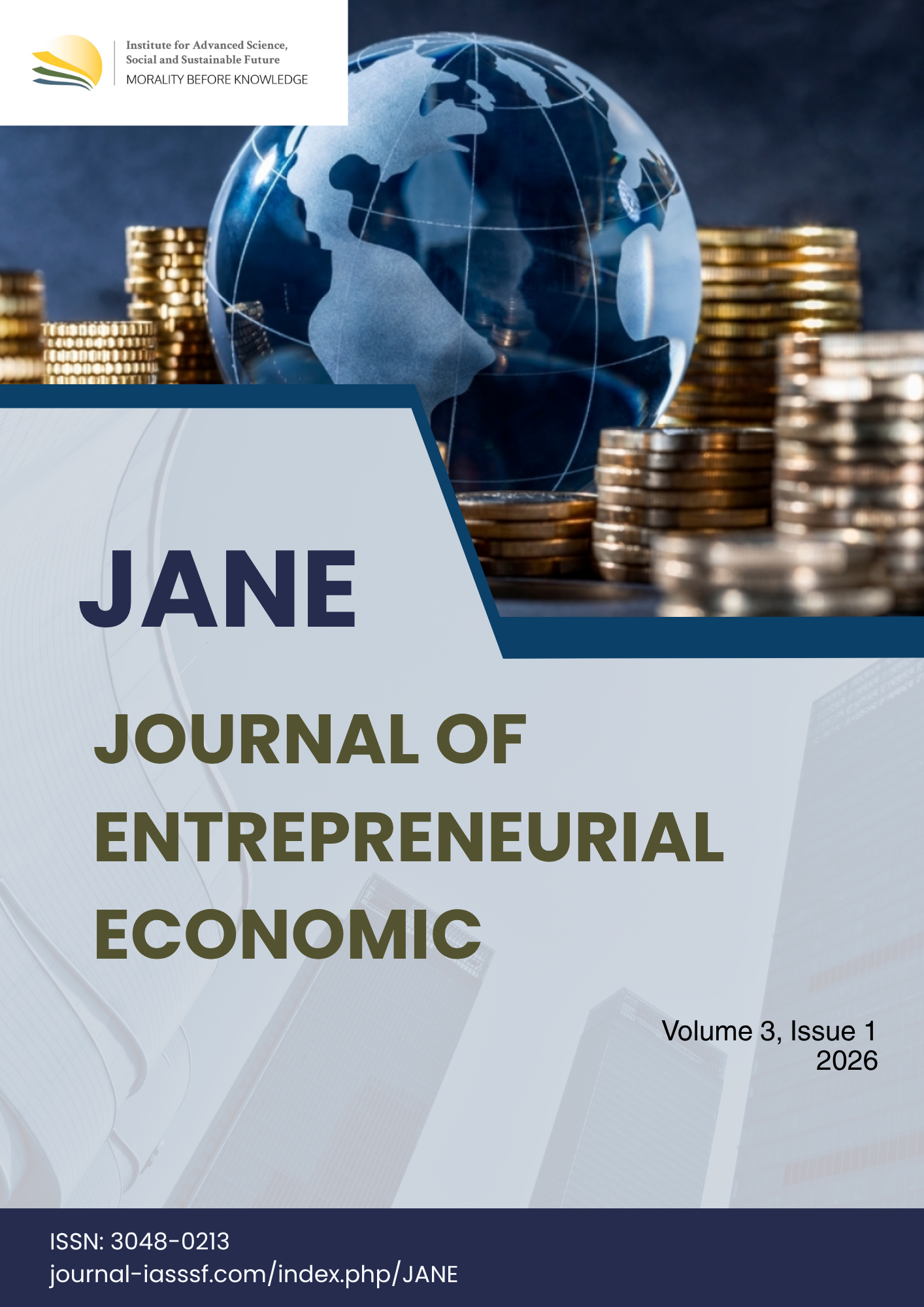
A sandbox regulatory framework for bullion integration in the decentralised digital finance (DeFi) ecosystem
DOI:
https://doi.org/10.61511/jane.v3i1.2026.3397Keywords:
sandbox regulatory, digital finance, bullion, regulator technologyAbstract
Background: This research addresses regulatory friction and systemic risks arising from the integration of tokenised bullion into the Decentralised Finance (DeFi) ecosystem, focusing on how to balance investor protection with continued innovation. It outlines the context of DeFi’s permissionless architecture, the sensitivity of bullion as a high value asset class, and the resulting challenges for regulatory certainty and market integrity. Methods: The study employs an analytical and conceptual approach based on a comprehensive literature review and the examination of international regulatory frameworks, including IOSCO principles and FATF recommendations. It develops an adaptive regulatory model by comparing existing rules on securities, commodities, and virtual assets with the specific risk profile of tokenised bullion in DeFi. Findings: The analysis identifies core conflicts between DeFi’s borderless, permissionless protocols and jurisdiction bound AML/KYC requirements, as well as single point of failure risks arising from custodial bullion structures. To address these conflicts, the paper proposes a DeFi Bullion Specific Regulatory Sandbox Framework grounded in technology neutral and risk based principles, which embeds regulatory KPIs, capital adequacy thresholds, and RegTech enabled real time monitoring. Conclusion: The results indicate that the proposed sandbox model offers a viable pathway to mitigate systemic risk and enhance regulatory certainty by enforcing compliance at critical on chain and off chain interaction points, particularly physical redemption of bullion. The framework strengthens investor protection while preserving space for innovation in tokenised bullion markets. Novelty/Originality of this article: This research delivers a comprehensive and actionable regulatory blueprint tailored to tokenised bullion in DeFi, explicitly addressing jurisdictional arbitrage and dual asset integrity issues. Its original contributions include defining technical prerequisites for embedding AML compliance into DAO governance and outlining a cross border mandatory liquidation protocol as a theoretical roadmap for regulators and industry stakeholders.
References
Adhami, S., & Guegan, D. (2020). Crypto assets: the role of ICO tokens within a well-diversified portfolio. Journal of Industrial and Business Economics, 47(2), 219–241. https://doi.org/10.1007/s40812-019-00141-x
Adrian, Tobias., & Mancini-Griffoli, Tommaso. (2019). The rise of digital money. International Monetary Fund. https://www.imf.org/-/media/files/publications/ftn063/2019/english/ftnea2019001.pdf
Baur, D. G., & Lucey, B. M. (2010). Is Gold a Hedge or a Safe Haven? An Analysis of Stocks, Bonds and Gold. Financial Review, 45(2), 217–229. https://doi.org/10.1111/j.1540-6288.2010.00244.x
Biais, B., Bisiere, C., Bouvard, M., & Casamatta, C. (2018). The Blockchain Folk Theorem. SSRN Electronic Journal. https://doi.org/10.2139/ssrn.3108601
Braband, S. (2024). <p><span>The role of Proof of Reserves in enhancing trust and transparency in Digital Currency and Digital Asset Systems</span></p> https://doi.org/10.2139/ssrn.4997049
CITI. (2023). Future of Cross-Border Payments: Who Will Be Moving $250 Trillion in the Next Five Years? https://www.citigroup.com/global/insights/future-of-cross-border-payments-
FATF. (2023). TARGETED UPDATE ON IMPLEMENTATION OF THE FATF STANDARDS ON VIRTUAL ASSETS AND VIRTUAL ASSET SERVICE PROVIDERS. www.fatf-gafi.org
Dewi, K. N., & Kurniawan, I. G. A. (2025). Cryptocurrency and Digital Asset Regulation. Pena Justisia: Media Komunikasi Dan Kajian Hukum, 24(1), 7896–7912. https://doi.org/10.31941/pj.v24i2.7141
Dhali, M., Hassan, S., & Zulhuda, S. (2024). The regulatory puzzle of decentralized cryptocurrencies: Opportunities for innovation and hurdles to overcome. Journal of Infrastructure, Policy and Development, 8(6). https://doi.org/10.24294/jipd.v8i6.3377
Dias, R., Pereira, J. M., & Carvalho, L. C. (2022). Are African Stock Markets Efficient? A Comparative Analysis Between Six African Markets, the UK, Japan and the USA in the Period of the Pandemic. Naše Gospodarstvo/Our Economy, 68(1), 35–51. https://doi.org/10.2478/ngoe-2022-0004
Díaz, A., Esparcia, C., & Huélamo, D. (2023). Stablecoins as a tool to mitigate the downside risk of cryptocurrency portfolios. The North American Journal of Economics and Finance, 64, 101838. https://doi.org/10.1016/j.najef.2022.101838
FSB. (2017). Financial Stability Implications from FinTech: Supervisory and Regulatory Issues that Merit Authorities’ Attention. www.fsb.org/emailalert
Goforth, C. R. (2021). Regulation of Crypto: Who Is the Securities and Exchange Commission Protecting? American Business Law Journal, 58(3), 643–705. https://doi.org/10.1111/ablj.12192
Grennan, J. (2022). FinTech Regulation in the United States: Past, Present, and Future. SSRN Electronic Journal. https://doi.org/10.2139/ssrn.4045057
Grieves, M. (2015). Digital Twin: Manufacturing Excellence through Virtual Factory Replication. https://www.3ds.com/fileadmin/PRODUCTS-SERVICES/DELMIA/PDF/Whitepaper/DELMIA-APRISO-Digital-Twin-Whitepaper.pdf
Guillaume, F., & Riva, S. (2022). Blockchain Dispute Resolution for Decentralized Autonomous Organizations: The Rise of Decentralized Autonomous Justice. SSRN Electronic Journal. https://doi.org/10.2139/ssrn.4042704
Harvey, C. R., Ramachandran, A., & Santoro, J. (2020). DeFi and the Future of Finance. SSRN Electronic Journal. https://doi.org/10.2139/ssrn.3711777
Hou Sak, M. (2024). KYC/AML Technologies in Decentralized Finance (DeFi). Stern NYU. https://www.stern.nyu.edu/sites/default/files/2024-07/Glucksman_Sak_2024.pdf
Islam, M. Z., Islam, M. S., Das, B. C., Reza, S. A., Bhowmik, P. K., Bishnu, K. K., Rahman, M. S., Chowdhury, R., & Pant, L. (2025). Machine Learning-Based Detection and Analysis of Suspicious Activities in Bitcoin Wallet Transactions in the USA. Journal of Ecohumanism, 4(1). https://doi.org/10.62754/joe.v4i1.6214
Kumar, S., Suresh, R., Liu, D., Kronfellner, B., & Kaul, A. (n.d.). Relevance of on-chain asset tokenization in “crypto winter.” ADDX. https://addx.co/insights/bcg-addx-report-asset-tokenisation-to-grow-50x-into-us-16-trillion-opportunity-by-2030/
Marston, R. (2020). Gold hits record high as investor jitters spread. BBC. https://www.bbc.com/news/business-53555771
McLaughlin, E., & Pecchenino, R. (2022). Fringe banking and financialization: Pawnbroking in pre‐famine and famine Ireland. The Economic History Review, 75(3), 903–931. https://doi.org/10.1111/ehr.13132
Muradyan, S. V. (2023). Digital Assets: Legal Regulation and Estimation of Risks. Journal of Digital Technologies and Law, 1(1), 123–151. https://doi.org/10.21202/jdtl.2023.5
OECD. (2024). The Limits of DeFi for Financial Inclusion. OECD Publishing. https://doi.org/10.1787/f00a0c7f-en
Riles, A. (2013). Managing Regulatory Arbitrage: A Conflict of Laws Approach. SSRN Electronic Journal. https://doi.org/10.2139/ssrn.2335338
Rohr, J., & Wright, A. (2017). Blockchain-Based Token Sales, Initial Coin Offerings, and the Democratization of Public Capital Markets. SSRN Electronic Journal. https://doi.org/10.2139/ssrn.3048104
Tao, F., Cheng, J., Qi, Q., Zhang, M., Zhang, H., & Sui, F. (2018). Digital twin-driven product design, manufacturing and service with big data. The International Journal of Advanced Manufacturing Technology, 94(9–12), 3563–3576. https://doi.org/10.1007/s00170-017-0233-1
Werbach, K. (2018). The Blockchain and the New Architecture of Trust. The MIT Press. https://doi.org/10.7551/mitpress/11449.001.0001
World Bank Group. (2020). Global Experiences from Regulatory Sandboxes. World Bank Group.
World Bank Group. (2024). The Middle Income Trap. World Bank Group.
Zetzsche, D. A., Arner, D. W., & Buckley, R. P. (2020). Decentralized Finance. Journal of Financial Regulation, 6(2), 172–203. https://doi.org/10.1093/jfr/fjaa010
Zetzsche, D. A., Buckley, R. P., Arner, D. W., & Barberis, J. N. (2017). From FinTech to TechFin: The Regulatory Challenges of Data-Driven Finance. SSRN Electronic Journal. https://doi.org/10.2139/ssrn.2959925
Downloads
Published
How to Cite
Issue
Section
Citation Check
License
Copyright (c) 2026 Aidatul Fitriyah, Beckham Napitupulu

This work is licensed under a Creative Commons Attribution 4.0 International License.