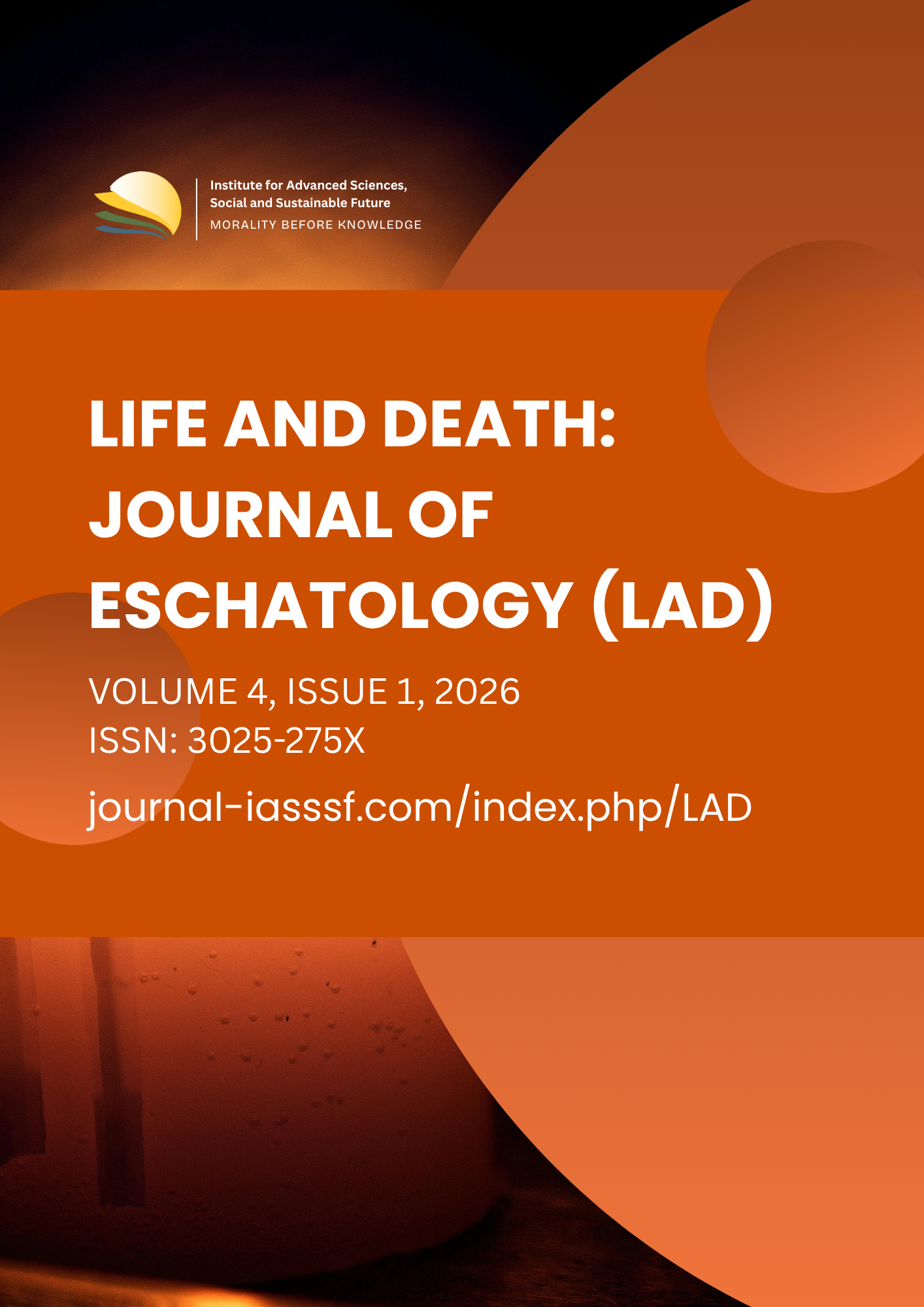
Free will, karma, and the cycle of death and rebirth: Rethinking determinism in Buddhist eschatology
DOI:
https://doi.org/10.61511/lad.v4i1.2026.2373Keywords:
Buddhism, determinism, divinity, freedom, free willAbstract
Background: The debate over determinism and free will has traditionally centered on whether divine causation is compatible with human freedom, framed through compatibilist and incompatibilist positions in Western philosophy. Buddhist philosophy reframes this problem entirely: rather than divine will, it is karmic causality, the causal chain binding beings to samsara, the cycle of death and rebirth, that raises the question of whether freedom is possible at all. This shift from theistic to karmic determinism offers a distinct eschatological lens, since liberation (nirvana) in Buddhist thought is precisely the transcendence of causally-determined rebirth through the exercise of will, ethical action, and insight. Methods: This article analyzes Buddhist teachings on karma, dependent origination (pratītyasamutpāda), and liberation as a framework for resolving the determinism–free will debate, contrasted with Western theistic compatibilism and incompatibilism. Findings: Buddhist philosophy suggests karmic determinism and freedom are not strictly opposed: causal conditioning shapes but does not fully determine action, leaving space for volitional transformation (cetanā) that enables escape from the death-rebirth cycle. This reframes the classical debate around a soteriological rather than theological axis. Conclusion: Buddhist teachings offer a distinct eschatological resolution to the determinism–free will problem, locating freedom not in opposition to divine will but in the capacity to transcend karmic causality and the cycle of death and rebirth. Novelty/Originality of this article: This article shifts the determinism–free will debate from a theistic to a karmic-eschatological framework, addressing questions of mortality and liberation absent from Western treatments of the problem.
References
Adam, M. T. (2010). No self, no free will, no problem: Implications of the Anattalakkhana Sutta for a perennial philosophical issue. Journal of the International Association of Buddhist Studies, 33(1-2), 239-265. https://journals.ub.uni-heidelberg.de/index.php/jiabs/article/view/9280
Bernier, P. (2019). Causation and free will in early Buddhist Philosophy. Buddhist Studies Review, 36(2), 191-220. https://doi.org/10.1558/bsrv.36779
Bhikkhu Boddhi. (2000). Paticcasamuppadasutta: 12.1. Dependent Origination. Sutta Central.
Bhikkhu Nanamoli & Bhikkhu Bodhi. (2026). Sammaditthi Sutta: Pandangan benar. Dhamma Citta.
Bhikkhu Sujato. (2018a). Anattalakkhanasutta: The characteristic of not-self. Sutta Central.
Bhikkhu Sujato. (2018). Nibbedhikasutta: Penetrative. Sutta Central.
Bhikkhu Thanissaro. (1996). Maha-vibhnga Sutta: An analysis of the path. Dhammatalks.
Caruso, G. D. (2020). Buddhism, free will, and punishment: Taking Buddhist ethics seriously. Zygon, 55(2), 474-496. https://doi.org/10.1111/zygo.12599
Federman, A. (2010). What kind of free will did the Buddha teach? Philosophy East and West, 60(1), 1–19. http://www.jstor.org/stable/40469162
Fischer, J. M., & Kane, R. (2007). Four views on free will. Blackwell Publishing.
Javanaud, K. (2018). Reformulating the buddhist free will problem: Why there can be no definitive solution. Journal of Indian Philosophy, 46, 773-803. https://doi.org/10.1007/s10781-018-9362-6
Kleinnman, P. (2013). Philosophy 101: From Plato and Socrates to ethics and metaphysics, an essential primer on the history of thought. Adams Media.
Magnis-Suseno, F. (2006). Menalar Tuhan. Penerbit Kanisius.
McCann, H. (2005). The author of sin? Faith and Philosophy, 22(2), 144–159. https://doi.org/10.5840/faithphil200522248
Moore, D. (2023). A nonreductive physicalist libertarian free will. Inquiry, 1-27. https://doi.org/10.1080/0020174X.2023.2166982
O'Connor, T., & Franklin, C. (2022). Free will. Stanford Encyclopedia of Philosophy. https://plato.stanford.edu/entries/freewill/#NatuFreeWil
Rakos, R., Rehfeldt, R., & Killeen, P. (2025). The free will: Determinism debate in contemporary science and society (or: why are you reading this article?). Perspectives on Behavior Science, 48, 475-497. https://doi.org/10.1007/s40614-025-00447-3
Repetti, R. (2012). Buddhist hard determinism: No self, no free will, no responsibility. Journal of Buddhist Ethics, 9, 130–197. https://buddhism.lib.ntu.edu.tw/en/search/search_detail.jsp?seq=388415
Repetti, R. (2014). Buddhist meditation and the possibility of free will. Science, Religion, and Culture, 2(2), 81-98. https://doi.org/10.17582/journal.src/2015/2.2.81.98
Startup, R. (2021). Free will and determinism: Resolving the tension. Open Journal of Philosophy, 482-498. https://doi.org/10.4236/ojpp.2021.114032
Tadic, J. M. (2026). Problem of free will in determinism and indeterminism. Philosophies, 11(81), 1-12. https://doi.org/10.3390/philosophies11030081
Timpe, K. (2006). Free will. https://iep.utm.edu/freewill/
Vicens, L. (2014). Theological determinism. https://iep.utm.edu/theo-det/
Warfield, T. (2000). Causal determinism and human freedom are incompatible: A new argument for incompatibilism. Philosophical Perspectives: Action and Freedom, 14, 167–180. https://doi.org/10.1111/0029-4624.34.s14.9
Westen, P. (2005). Getting the fly out of the bottle: The false problem of free will and determinism. Buffalo Criminal Law Review, 8(2), 599–652. https://doi.org/10.1525/nclr.2005.8.2.599
Winters, J. (1994). Thinking in Buddhism: Nagarjuna's middle way. Baha'i Library. https://bahai-library.com/pdf/w/winters_nagarjuna.pdf
Downloads
Published
How to Cite
Issue
Section
Citation Check
License
Copyright (c) 2026 Jessica

This work is licensed under a Creative Commons Attribution 4.0 International License.